
Warren County 72-Hour Release Access
No separate Warren County 72-hour URL or filter was found in the Sheriff’s navigation or the Miami Valley Jails interface as of July 31, 2026. The official jail information page links to the public custody system, but that system is labeled for people currently in custody. It cannot be relabeled as a rolling release archive.
For a true three-day list, ask the Sheriff whether its jail-management system maintains an existing release report for a precise start and end time. The request should identify the Warren County Jail and the exact interval. Seek fields already kept by the office, such as name, booking number, release date and time, disposition, releasing authority, and receiving agency. A request for an existing report is different from asking staff to research or create a new narrative.
Request Warren County Three-Day Releases
A three-day interval needs firm boundaries. Use dates, times, and the local time zone so the records custodian can identify the existing jail report. If the goal is to verify one named person, request that person’s release screen instead of a countywide list. A narrow request is easier to match and can reduce copy volume.
- Choose the exact start and end of the 72-hour period. State both dates and times.
- Submit the request through the Warren County Sheriff records page, or use another channel allowed by the Sheriff’s public-records policy.
- Ask whether an existing release log or report covers that interval. List the specific fields sought.
- Review each disposition. Separate bond, recognizance, sentence completion, and dismissal from transfer or another hold.
- Match entries to the correct Warren County court docket. Use ODRC for any state-prison transfer.
Ohio public-records law allows prompt inspection and copies within a reasonable period, subject to exemptions. It does not impose one fixed response time for every request. Protected parts may be redacted. Ask for electronic delivery when available and request a cost estimate if the report is large.
Readers focused on the current day can use the narrower method on the Warren County 24-Hour Releases page. For one known person across all documented channels, start with the Warren County released-inmate lookup. Neither interval should be rebuilt by comparing screenshots of the live roster.
Warren County 72-Hour Record Fields
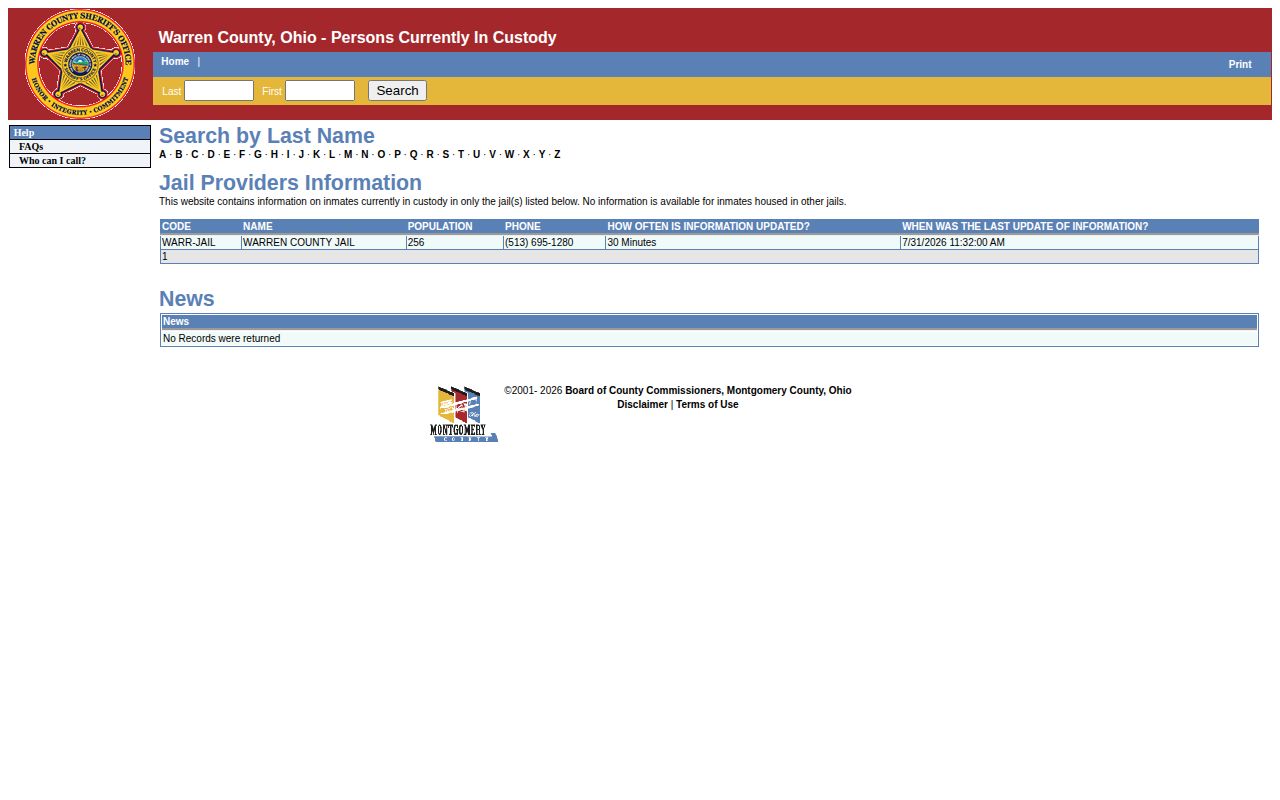
The public custody landing page lists current-search controls, jail contact details, a changing population value, update frequency, and a last-update time. Those are current-roster fields. A three-day release report needs departure fields from the Sheriff’s underlying record.
| Field to request | How it supports the three-day review |
|---|---|
| Full name | Identifies the person, but should be paired with another identifier. |
| Booking or jacket number | Links the departure to one Warren County Jail episode. |
| Booking date and time | Helps separate repeat bookings and similar names. |
| Release date and time | Determines whether the departure falls inside the exact 72-hour window. |
| Release disposition | Explains bond, recognizance, time served, dismissal, completion, transfer, or another event. |
| Releasing authority | Points to the court or agency record that authorized the action. |
| Destination or receiving agency | Distinguishes return to the community from continued custody. |
Not all fields will be public in every case, and an office may redact protected information. Juvenile records follow special confidentiality rules. A booking image, if kept and disclosable, is a separate related item and does not prove the release date or destination.
Note: Ask for the disposition and receiving agency because a Warren County Jail departure can lead to the community, ODRC, or another custodian.
Warren County Weekend Release Checks
A 72-hour frame can bridge a weekend or holiday, but it does not create an official feed where none exists. Court orders, bond completion, jail processing, and data updates can occur at different times. “Bond set,” “bond posted,” “release ordered,” and “released” are separate events. The journalized order provides the legal basis. The jail release entry supplies the actual departure time.
Warren County’s public roster states a 30-minute update cycle, but that interval applies to current custody data. It is not a promise about release-report publication or historical retention. A person may leave near the edge of a requested interval, so specify the exact hours and check whether the report uses processing time or another recorded time.
The Warren County Court of Common Pleas and the correct lower court can show bond, sentencing, judicial-release, or dismissal entries. Docket updates do not prove that jail processing finished at the same moment. Ask the Clerk for the actual journal entry when its precise terms matter.
Warren County Court serves several townships and handles criminal matters within its authority. Mason Municipal Court serves Mason and Deerfield Township, while Franklin and Lebanon maintain separate municipal-court paths. A felony can begin in a lower court and continue under a new Common Pleas case number. Search both records when the charge history suggests a bind-over. A preliminary dismissal may reflect that transition, so it should not be read alone as a final outcome or a release time.
Warren County Roster Release Clues
Warren’s current roster is valuable because it states its scope and cadence plainly. It reports current inmates, says no information is available for people in other jails, and lists a 30-minute update frequency. This creates a useful local rule: disappearance after a refresh is a lead, never a release certificate.
The Miami Valley Jails Warren County page below shows the current-custody search context and update notice.
A released name may vanish from view, but so can a person transferred to ODRC or another authority. Data changes, spelling differences, and court transport can also affect what a reader sees. The Sheriff release record resolves the local departure. ODRC, BOP, or ICE records resolve the next custodian when those paths are plausible.
Verify Warren County Release Outcomes
Every three-day entry should be read by release type. Bond or recognizance ends that detention episode while the case continues. Time served means the custodial part was credited or completed but does not rule out supervision or another case. A transfer is continued custody. A dismissal can end one charge while another hold remains.
| Custody path | Primary verification source | What confirms the outcome |
|---|---|---|
| Warren County Jail to community | Sheriff release record and court docket | Release time, community disposition, and matching order |
| Warren County Jail to Ohio prison | ODRC Offender Search | ODRC admission, institution, and status |
| Ohio prison to supervision | ODRC record and APA information | Release status, actual date, and supervision status |
| Federal custody | BOP Inmate Locator | Federal status and release date, checked against the federal case |
| Possible immigration transfer | ICE Online Detainee Locator | Current ICE result or direct agency confirmation |
Ohio SAVIN through VINELink can report a custody event for a specific person and can send future alerts when the participating agency supplies an update. It is not a historical county list. Verify a release alert with the reporting jail or ODRC, especially when the destination is unclear.
Warren County Release History Limits
No online retention period for former Warren County roster entries was found. The public refresh rate does not tell how long the Sheriff keeps the underlying release log or jail jacket. The Sheriff’s records policy and a response from the custodian are the proper sources for the availability of a particular interval.
Court records may provide a longer trail. Warren County Common Pleas offers full case histories for cases filed since May 1991, while older online entries from 1980 through May 1991 may be limited to a reference number and caption. Its inquiry updates during the business day and overnight, but it does not supply actual filed documents online. A Clerk request is needed for the journalized order.
ODRC preserves a separate state-corrections history for people who entered Ohio prison or Adult Parole Authority supervision. It does not cover a person whose only custody was the county jail. Keeping these record systems separate prevents a three-day county request from being mistaken for a statewide release search.
The Sheriff’s release file and the court docket also have different roles. The jail record proves when the local detention episode ended and can identify a receiving agency. The journalized order explains the legal authority. ODRC then becomes relevant only if the person entered state prison or state supervision. Where a federal writ or detainer is involved, a gap can exist before the final federal custodian appears in BOP data. That gap is not evidence of unrestricted release.
Note: State-prison releases from LeCI or WCI belong to ODRC records even though both institutions are located in Warren County.